Visiting Aitutaki
Lagoon, Cook Islands
for your vacation is one of the best vacation destination decisions you
may ever make. The Aitutaki lagoon is as idyllic a place as you will
ever find; many poets and writers have spun thousands of lines
describing its wonders and beauty. Matriki Beach Huts was built on the
foundation
that all people should be able to enjoy this splendor without the high
costs associated with such remote travel. Aitutaki lagoon offers snorkeling,
diving,
fishing,
whale
watching, picnicking
on beautiful
beaches, sailing, kayaking,
and much more. While snorkeling, you can view a myriad of colorful
fish and see first-hand the
giant clams of Aitutaki and the South Pacific; these clams
are now protected in four separate reserves in the Aitutaki lagoon. Bone
fishing is a thrill all its own - although we don't eat the
fish they are truly a rush to stalk and catch. Fishing
for pelagic species outside of the Aitutaki lagoon offers up Yellow
Fin Tuna (Ahi), Dorado
(dolphin fish), Wahoo,
and array of jacks and snapper. Bring some of your catch back for the
BBQ. At Matriki
Beach Huts we practice fishing conservation - never kill what you can't
eat in a
few days, and never kill billfish.
The local Aitutaki scuba
diving operators will safely show you some of the Cook
Islands best diving; they are safe, reliable, and very knowledgeable.
Matriki Beach Huts has hobies for hire, sail the Aitutaki lagoon and
discover what
all the fuss is about for yourself. Your hosts are always there to
answer questions, take you on tours, sailing adventures, fishing trips,
and more.
At the very centre of the Polynesian triangle, the Cook
Islands consist of 15 islands scattered over some 2 million
square kilometres of the Pacific Ocean. It is bordered to the west by
Tokelau, the Samoas and Nuie and to the east by Tahiti and the islands
of French Polynesia. It lies in the Tropic of Capricorn, latitude from
9-22 degrees. The islands north to south, are Penhryn, Rakahanga,
Manihiki, Pukapuka, Nassau, Suwarrow, Palmerston, Aitutaki, Manuae,
Mitiaro, Takutea, Atiu, Mauke, Rarotonga and Mangaia. With a land area
of just 240 square kilometres, the islands range from low coral atolls
to the mountainous majesty of Rarotonga, the largest island of the
group and home to the capital, Avarua. Aitutaki is known as the lagoon
of the South Pacific and a Cook Islands vacation is not complete
without a visit to Aitutaki. Legend has it that
Aitutaki’s highest point, the 124-metre Maungapu, is the top of
Rarotonga’s Raemaru Peak, stolen away by local warriors.
It was during the Great Polynesian Migration (which began about
1500BC), that our ancestors first arrived in the South Pacific islands. Their giant
double-hulled canoes - ‘Vaka’s’ - guided by the stars and the power of
ancient Polynesian navigation, arrived here in the Cook Islands approximately 500AD. It is
said that Chief Taoi arrived in Rarotonga during that time. Taoi presided over the creation of a grand road, built of
coral, laid through the inland swamps. This all-weather road is still
in existence, despite being almost 1000 years old. Now tar sealed, it
lies inland and is called the Ara Metua. When the early explorers
arrived on Rarotonga, they were staggered to find the Great Road of Toi
and while there’s much in the way of legends to explain its presence,
the original reason for its construction remains shrouded in mystery.
There was no further European
contact until over 160 years later in 1773, when Captain James Cook,
for whom the island group was eventually named, sighted Manuae atoll
which he named Hervey Island. On a later voyage, he also discovered
Palmerston, Takutea, Mangaia and Atiu in 1777.
The ill fated Captain
William Bligh sighted Aitutaki in 1789. Shortly after
Bligh, on April 28th 1789, mutineer Fletcher
Christian sighted Rarotonga following the famous “Mutiny on the
Bounty”. However Rarotonga’s official discovery is credited to Captain
Phillip Goodenough in the Cumberland in 1814, whilst seeking sandalwood.
Aitutaki was the
first island in the Cook islands group to embrace Christianity when the
Reverend John Williams of the London Missionary Society arrived in
1821. Traveling with Williams was a young missionary, Papeiha, from the
Society Islands, who stayed on when Williams continued his travels and
dedicated the rest of his life to his task. The CICC Church,
construction of which started in 1828, is the oldest church in the Cook
Islands and has a memorial to John Williams and Papeiha.
The Cook
Islands became a favorite stop for whalers in the 1850s, the British
flag was raised in 1888 at which time Aitutaki and Rarotonga were
included in the boundaries of New Zealand.
Today, our international airport in Rarotonga handles daily connections
by modern jet aircraft. Your local travel agent can assist you with
reservations and planning your holiday, thus making the discovery of
your Cook Islands vacation much easier for you than for our ancestors.
The
Cook Islands History
An islands
group of the southern Pacific Ocean southeast of Samoa. Probably first
inhabited by Polynesians more than 1,500 years ago, the Cook Islands
were sighted by Capt. James Cook in 1773. In 1773, Captain
James Cook sighted Manuae atoll which he named Hervey Island.
On a later voyage he discovered Palmerston, Takutea, Mangaia, and Atiu.
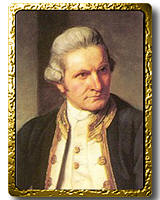
Captain James
Cook.
The Cook Islands are made up of 15 distinct islands, a Northern group
and a Southern Group. Rarotonga is the capital of the Cook islands. The southern group is nine "high" islands mainly of
volcanic origin although some are virtually atolls. The majority of the
Cook Islands population lives in the southern group. The northern group
comprises six true atolls.The
islands of the Cook group have a total land area of about 240 square kilometers,
scattered over a vast 2 million square kilometer area of South Pacific
Ocean.
A former British protectorate, the Cook Islands became a self-governing
state in free association with New Zealand on August 4, 1965. This day
is now celebrated as Constitution Day.
Population: 18,000 (2004) - Source: United Nations. More than three times as
many native Cook Islanders live in New Zealand than live in the islands
themselves. As New Zealand citizens, they are free to live in both
Australia and New Zealand.
Rarotonga is the international entry point for the Cook Islands. From
Rarotonga international airport Cook Islands carrier Air Rarotonga
flies to most of the other islands in the group.
There are no snakes and no poisonous insects or animals on the Cook
Islands.
Islands group (pop., 2005 est.: 13,900), southern Pacific Ocean.
Located roughly 3,000 km northeast of New Zealand, the 15
islands, scattered from north to south over some 1,450 km of
ocean, are divided into a southern group of nine islands, including
Rarotonga (the seat of government), and a northern group of six. All in
the northern group are true atolls; most in the southern group have
volcanic interiors. They were probably settled by Polynesians from
Tonga and Samoa; there is evidence of a highly organized society c. AD
1100. Capt. James Cook
explored many of them during the 1770s. Established as a British
protectorate in 1888, they were annexed by New Zealand in 1901.
Self-government in free association with New Zealand was achieved in
1965. Aitutaki is considered the vacation island of the Cook Islands.
Aitutaki,
facts
An
Aitutaki Cook Island vacation is the stuff of which dreams are made.
This magnificent and remote island has a triangular-shaped 'almost'-atoll
rising up 4000 meters from the floor of the Pacific Ocean. It consists
of three volcanic and 12 coral islets (motus)
Aitutaki was probably first settled around 800 AD and one of its great
legendary Polynesian Outrigger canoe discoverers was Ru who named it
Utataki Enua O Ru Ki Te Moana. Roughly translated, this means The
Leading of a Cargo of People by Ru Over the Ocean. It can be inferred
that Aitutaki was, therefore, the ultimate destination of one of the
great
Polynesian
ocean voyages. The first recorded discovery by Europeans was Captain
Bligh on the "Bounty".
He arrived on April 11 1789 and shortly afterwards the famous mutiny
occurred. Bligh returned later on July 25 1792. He is credited with
introducing the paw
paw fruit to Aitutaki Island and this is now an important
export product from the Cook Islands.
The first missionary to the Cook Islands, John
Williams, landed on Aitutaki before any of the other Cook
Islands and there is a large, airy coral block church in Arutanga, the
main township, which bears testament to his success in converting the
people to Christianity.
Life on Aitutaki moves at a wonderfully relaxed tempo which is why it
is such a popular destination for visitors who fly in from Rarotonga
for day trips as well as extended stays. Akaiami The Aitutaki lagoon can
be approached in leisurely fashion in traditional outrigger
canoes for quiet paddling just off the beach or in more sophisticated
launches favored by foreign anglers who know its reputation for
saltwater fly fishing for the fighting bonefish.
The motus which are mainly at the outer perimeter of the lagoon are
wonderful landing places for the day cruises available for visitors.
The favorite islets are Akaiami and One Foot Island.
Useful
Information for Visitors to the Cook islands and Aitutaki.
Public Holidays
The Cook Islands have 11 public holidays. On these days, bus service is
either irregular or non existent. The Cook Islands shops are closed.
Some little shops are open either in the morning and evening. Many
restaurants are closed. If you are holidaying during this time then
please make sure you stock up and you arrange transport to cover you
over the holidays.
Our holidays are as follows:
New Years Day - 1 Jan
Day after New Years - 2 Jan
Good Friday
Easter Monday
ANZAC Day - 25 Apr
Queen's Birthday - 4 Jun
Rarotonga Gospel Day - 25 Jul
Constitution Day - 4 Aug
CI Gospel Day - 26 Oct
Christmas Day - 25 Dec
Boxing Day - 26 Dec
Being stuck without food and transport on any of these days can ruin
your holidays. Please note that Sundays are similar to public holidays.
Respect
of Traditions
The Cook Islands is a religious nation. One of the reasons why the
country is safe is because most people go to church or believe in God.
Part of this is that the people are very modest people. We do not
appreciate nudity of any form. If you are sunbathing please do not
sunbathe naked, keep your togs or bikinis on. Also, when driving around
in town, or walking through the town shops please do not walk around in
bikinis. And please do not wear shorts or a singlet if you attend a
church service.
Cook
Islands Foods to try
You should try our 'ika
mata' - marinated raw fish in coconut cream and lemon juice.
Trust me, the lemon juice cooks the fish so it's not as raw as its name
suggests. It's really nice.
Other food you should try is 'poke'
- banana or pawpaw
pudding. This is basically banana or pawpaw mixed with
arrowroot/cassava flour and served with coconut cream. It's rich but
its an experience.
Try our root crops, or our staples - taro, arrowroot,
kumara.
A lot of visitors don't like taro, they say it tastes like soap, but we
locals like it. Maybe the trick is that you don't eat it by itself, you
cut a bit off and eat it with raw fish. Most visitors prefer kumara,
the sweet potato, we have this in many different colours - purple,
white, orange, yellow, but they are still the same thing.
Coconut juice - we call it 'nu'. It's a very pleasant drink so try it
at least once. You can get them at the market for about $1-$4. The
locals
think $4 is expensive but that's the price you pay if you don't want to
get your own off the tree.
Mayonnaise - It's a dressing in your part of the world, but we have a
potato salad that is called that. The potato salad is mixed with
beetroot, chow chow and Bestfood mayonnaise. Locals love it. Mitiore
- This is grated coconut marinated in the juice of small white crabs
with sprinklings of spring onion and sea urchins.
Seafood - If you do visit Aitutaki and the outer Islands there is a lot
of different kind of seafood you can try like 'remu' - sea grapes, and
all kinds of sea urchins, crabs etc. Do not eat sea urchins straight
out of the sea as you may be unfamiliar with what is edible.
Currency
currency
converter
New Zealand Dollar. There are still some Cook Islands coins floating
around of which the 10c, 20c and 50c resemble the New Zealand and
Australian coins in terms of size and shape, so be careful not to take
them back with you unless you want to keep them of course. Otherwise,
there are still old Cook Islands $1, $2 and $5 coins in use. The New
Zealand denominations are 10c, 20c, 50c, $1, $2 coins and $5, $10,
$20, $50, $100 notes.
Good
Morning - põpongi
Good Night - põ manea, põ meitaki
Have a nice day - rã mãnea
Good bye - ‘aere ra
Come here - ‘aere mai
Thank you - meitaki
Thank you very much - meitaki atupaka
You are beautiful - te mãnea ‘iakoe
What
is... your name? - ko‘ai tõ‘ou ingoa?
the time? - ‘ea‘a teora?
Where is... the bus stop? - tei‘ea te ngai tãp~u anga o te bus?
the hospital? - tei‘ea te are maki?
the museum? - tei‘ea te are vairanga apinga takere?
the library? - tei‘ea te are vairanga puka tatau?
the bank? - tei‘ea te pangika?
the market? - tei‘ea te maakete?
the church? - tei‘ea te are pure?
where are going? - ka aere koe k~i‘ea
Counting
1-10
tai, rua, toru, ‘ã, rima, ono, itu, varu, iva, ta‘i nga‘uru
Useful words
Yes - ‘ãe
No - kãre
Stop - tãp~u
Flower - tiare
Food - kai (Rarotonga word for food), mãnga (-over the first a)
(Ngaputoru an Aitutaki word for food)
Book - puka
Water - vai
Girl - tamãi‘ne
Pretty girl - tama‘ine maneã
Woman/wife - vaine
Pretty woman - va‘ine manea
Boy - tamaiti
Man/husband - tãne

 Captain James
Cook.
Captain James
Cook.